
Fall apart. To rebuild.
In my life, metaphor has always provided the most potent source of meaning. As I do not adhere to the belief structures of any religion, I instead glean meaning in a curated sense, through exposure to the wider wisdom of mankind. I internalize philosophies and practices that reflect my lived reality, despite culture of origin or greater religious connotation. Essentially, I create my own meaning from the shared human experience, and embrace much of mankind’s teachings as inherently valid and helpful.
A practice that holds significant meaning to me originated in 15th century Japan. Rumor has it that a shogun sent a damaged piece of a ceremonial tea set to China for repair, and when he received it, the methods used had left it far less aesthetically pleasing than its previous form. The practice of Kintsugi arose from the desire to provide repair in a more aesthetically pleasing sense.
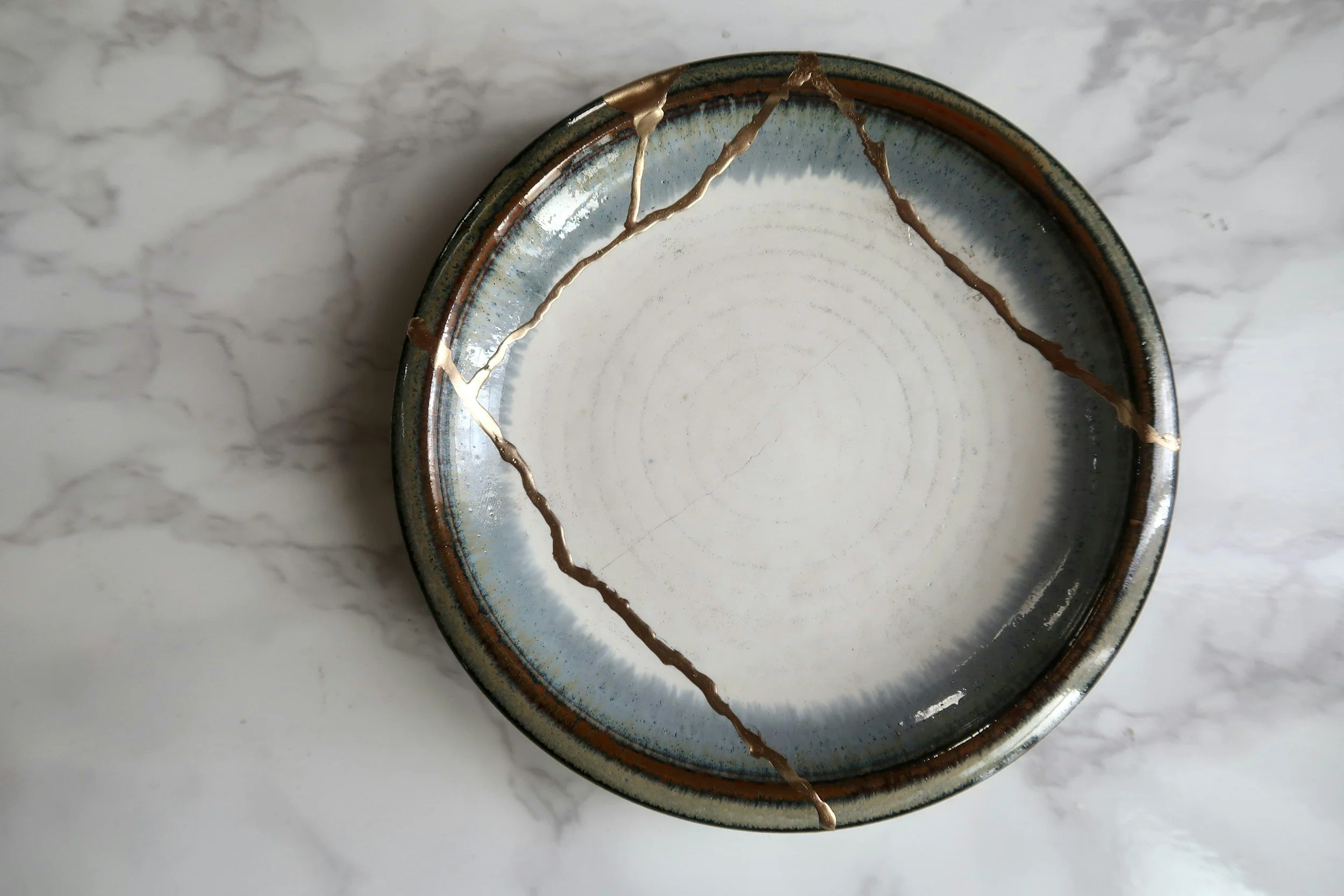
Kintsugi is the art of repairing broken ceramics with polymers mixed with gold. Instead of repairing the item in a manner that conceals any defects, Kintsugi highlights precisely where it was broken.
I stumbled across this practice in the mid-2010s, during a search for repairing broken models. It immediately caught my attention. The aesthetics were certainly appealing, but what stood out to me was the message it asserted:
That which is broken can be turned into something even more beautiful.
The object was not repaired in a fashion that would hide the cracks it had endured. Instead, it made their presence even more evident. This really spoke to me. We are taught to live our lives in a way that conceals the damage from our past experiences, to present a flawless and functional mask to the world, to conceal the cracks our spirits endure.
Instead, the art of Kinstugi says: “To be broken is a blessing. Our wounds hold inherent beauty.”
Since that discovery, Kinstugi has been the image that springs to my mind when I endure pain. It is the image I channel when helping someone who felt like they were broken. It meant so much to me, yet I had never taken part in the actual practice. It wasn’t until last year that I was presented the perfect opportunity.
A statue sits on the mantle above my fireplace. My parents had the same one in their house. After I expressed how much I liked it, my mother gave me one for christmas. It depicts a man engaged in a meditative pose which, to me, represents balance, human potential, endurance, discipline, and much more (I will be sharing a picture of it below so you don’t have to guess what it looks like). It stood as a silent guardian over my home, reminding me at all times to pursue balance, self-mastery, and inner peace.
Regrettably (inevitably), it met with an unfortunate circumstance. One day, the statue was exposed to a sudden force against an immovable object. It fell from the mantle onto the hardwood floors, and shattered into roughly 10 pieces. At first, I was devastated. It was a very meaningful piece to me, but I didn’t think that I would be able to find the time to put it back together.
That’s when it hit me. There was a practice that had provided such powerful symbolism to me throughout the decade, and now I had the perfect opportunity to apply it. I moved automatically, I found a Kintsugi repair kit, and within two days, I had him rebuilt.
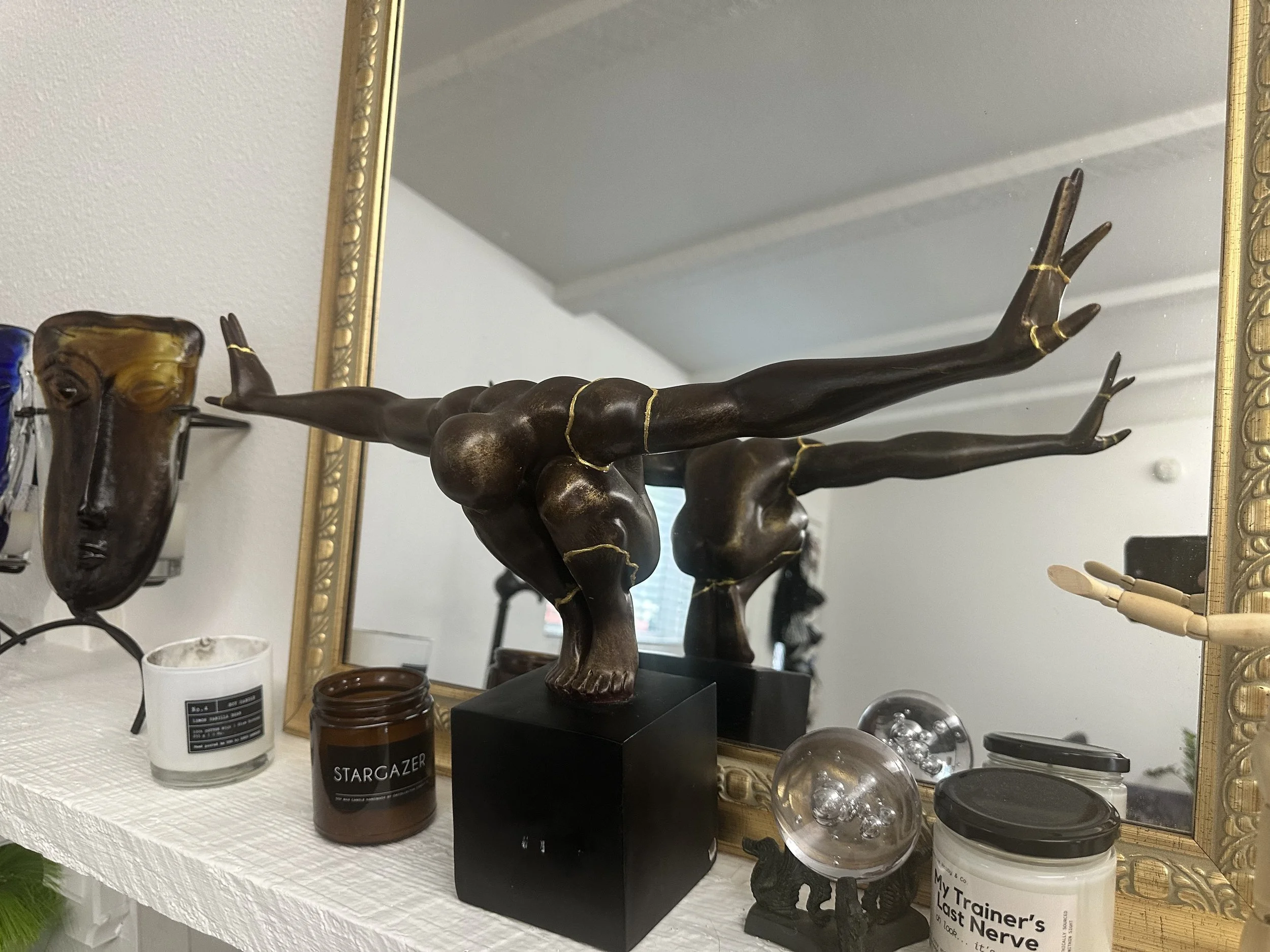
He looks even better now than he did previously.
The practice proved to be many things for me. At that time in my life, things were feeling quite shattered and out of balance. There were cracks spreading through many different domains. My physical health was on a downswing, I was plagued by chronic pain, autoimmune attacks, and excessive cortisol production. My financial health was struggling, I was trying to start a business from scratch, and had just been uprooted from my long-term housing situation for reasons out of my control. My emotional health was struggling, and the political and economic climates were taking a toll on me.
There I was, with all of that hanging over me, methodically repairing this icon of balance. I took the ritual seriously, I performed it in moderate silence, with few distractions. I was by myself, focused on this process of renewal, rebirth, and reconstruction.
The meditative trance of Kinstugi is like nothing I have experienced before. Beyond the satisfaction of seeing broken pieces slowly finding their way back to form, the practice is ripe with metaphorical meaning. Every joint along the cracked surfaces had a piece that fit perfectly. We all have wounds to heal, and their healing requires the right piece to be gently fit into the right place.
There was an order to the reconstruction. It could only be put back together if certain joints were repaired before others. If a piece was placed too early, despite fitting perfectly by itself, would block another piece from fitting back into its rightful place. In our pursuit of self-development, we cannot fix all of our problems at once. The process is step-wise. One foot in front of the other. If we focus on the wrong aspect too early, we can impede our ability to progress in other domains.
I had to move slow to move fast, and conversely, move fast to move slow. The epoxy in the kit is a rapidly drying compound. From the time of mixing, adding the gold dust, and incorporating it into the solution, there was a span of less than a minute before it hardened entirely. I had to move slow at first: find the right piece, make sure it fit its seam, check whether it would block another piece. Then, I moved fast. I had to mix the solution rapidly, and incorporate the right amount of the gold dust. The solution needed to be painted onto the surface, and the piece fit into place before it dried, all within that span of a minute. Then, it was back to moving slowly. Despite the solution’s tendency to dry rapidly when exposed to air, the pieces needed to be held together for awhile before the epoxy could hold the weight of the newly added piece.
It was such a unique flow state: smooth, mixing motions, accuracy in application, precision in placement, balance in the pressure applied, gradual, yet noticeable satisfaction in the return to the statue’s original form. Finally, my work was done, and through a diligent, patient process, this icon of balance, discipline and self-mastery had taken on a new kind of life, and an entirely new meaning.
I legitimately think it looks twice as impressive now with the gold running through it, and people who have seen it since just thought it was a part of the piece’s original design. I found that to be quite meaningful. We expend so much energy desperately attempting to conceal our wounds, but lose track of the positive ways they change us. This statue was shattered, stripped of its decorative function, only to become even more impressive with the evidence of its once broken state made obvious. It will never again be what it was, but now, it is something greater.
The most challenging part of our personal growth is incorporating the shadow of our psyche. Re-integrating our wounds instead of running from them or hiding them from view. Allowing ourselves to fully feel the pain, to process the grief of injustices we have suffered, or mistreatments we have endured. It is our duty to ourselves and the world that we do not deem ourselves too broken, too dysfunctional to repair, and that we do not allow ourselves to become warped, allowing ourselves to treat others in the same way we have been treated. Our act of personal Kintsugi is reshaping ourselves to become the antithesis of what caused our pain.
The art of Kinstugi is the art of reconstruction. Flawlessness does not equate to beauty. Anyone who has been at this discipline for some time knows the true nature of rupture and repair. Embracing what it means to be “broken”, yet capable of being repaired, is the ultimate lesson we can learn.
It is the key to picking up the brush and mending our wounds in gold.
Take care.